The following is an American Council for an Energy-Efficient Economy (ACEEE) press release from October 6, 2020.
Leading U.S. cities are expanding their clean energy efforts to tackle climate change, yet many more lag far behind, and only one-fifth have community-wide greenhouse gas reductions goals and are on track to meet them, according to the 2020 City Clean Energy Scorecard released Tuesday. New York City leaped to first place in the ranking—spurred in part by a new law ensuring upgrades to many inefficient buildings—followed by Boston and Seattle (tied for second place) and Minneapolis and San Francisco (tied for fourth place).
View the 2020 City Clean Energy Scorecard
The scorecard from the American Council for an Energy-Efficient Economy (ACEEE) analyzes the efforts of 100 major U.S. cities—home to 19% of the nation’s population—to make buildings and transportation more energy efficient and scale up the use of renewable energy. It provides the most comprehensive national measuring stick for climate progress and a roadmap for future improvements. Over time, the Scorecard has adopted metrics to assess community involvement and equity as part of cities’ clean energy efforts.
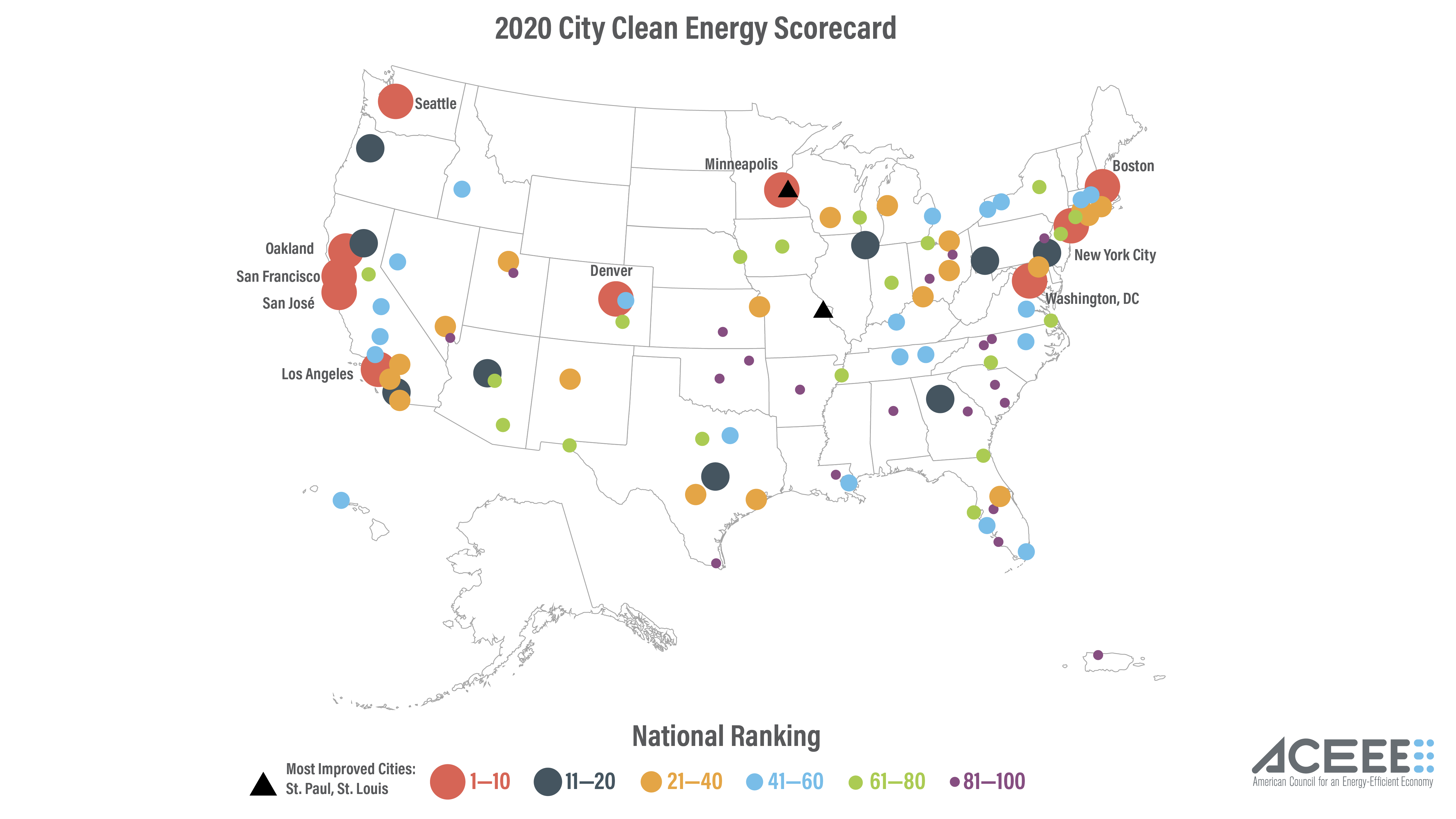
- Washington, DC; Denver; Los Angeles; San José; and Oakland rounded out the top 10 highest-ranked cities, with San José and Oakland making the top 10 for the first time.
- The top 10 cities embraced new actions. Boston and Los Angeles updated codes to require new buildings be pre-wired for electric vehicle charging stations at more parking spaces, and San Francisco convened a network to work with marginalized communities to establish equitable zero-emissions residential building strategies.
- St. Paul (#16) was the most-improved city, taking key steps to improve efficiency of existing buildings, reduce total vehicle miles traveled, and embrace renewable energy. St. Louis (#28) was the second-most-improved city; in April, it became the third city in the country to require large existing buildings to meet a performance standard, which will drive energy efficiency upgrades.
- More cities are making efforts to increase community engagement with, and clean energy investments in, low-income communities and communities of color. Washington, DC, formed an equity advisory group to develop recommendations to be incorporated in its clean energy plans. But nearly all cities have substantial room to ramp up their efforts.
- Bottom-scoring cities’ policy efforts have either stagnated or not started; these cities are years behind the leaders. To scale up climate efforts across the country, more cities will need to adopt and implement effective clean energy policies.
- Many cities are encouraging electric utilities and state regulators to increase the use of renewable energy in the power system. Twenty-four cities submitted comments on public utility commission proceedings, entered into utility partnerships, enacted community choice aggregation programs, or participated in planning efforts with utilities.
The report assesses policies adopted by May 1, 2020. The public health and economic devastation wrought by COVID-19, as well as the growing outrage over racial disparities and their impacts on communities of color, could cause city policy priorities to change. The report argues that as cities focus on economic recovery in the context of COVID-19, energy efficiency and renewable energy remain a crucial strategy for creating jobs and keeping investment within local communities. Furthermore, a closer focus on equitable planning and investment can yield benefits that have historically been unavailable to communities of color.
“City budgets are under enormous strain. Clean energy policies are part of the solution because they create jobs while reducing energy costs for households, businesses, and city government,” said Ribeiro. “By keeping up and expanding clean energy efforts, cities can support the economic recovery while combatting the climate crisis.”
Mark Chambers, director of sustainability for the City of New York, said: “This recognition is meaningful for our city, and a result of determined efforts by dedicated government and community leaders. There is still urgent action needed from New York, and all cities, if we are to truly confront the climate emergency.”
Seattle Mayor Jenny Durkan said: “City leadership on building energy efficiency and overall climate action is more important than ever. While the federal government has used its leverage to prop up polluting energy sectors, cities are stepping up with innovative and bold policies and programs—like our ban on heating oil—that are helping us transition away from dirty energy. Fossil fuels are damaging the health of our residents and our economy and I’m inspired by the all work happening in cities across the nation focused on reducing their use.”
St. Paul Mayor Melvin Carter said: “Clean energy is a critical part of responding to our ongoing climate crisis. We appreciate ACEEE’s important work, and its support of our efforts to build a more equitable, clean energy future in St. Paul.”
The scorecard ranks cities in five policy areas:
- Local government operations. Austin and Boston tied for the first spot. Each is on track to achieve its greenhouse gas mitigation goals for government operations and has policies to increase energy efficiency in purchasing decisions, construction practices, and asset management. Portland, San Francisco, and Washington, DC, tied for second.
- Community-wide initiatives. Washington, DC, was the leading city, adopting several greenhouse gas mitigation and clean energy goals informed by the community. Denver, Los Angeles, and Minneapolis tied for second.
- Buildings policies. New York earned the most points and was the only city to receive all possible points for city policies encouraging or requiring efficiency improvements in existing buildings. Seattle, Boston, and Chicago were the next-highest scorers.
- Energy and water utilities. Boston, Chula Vista (California), Minneapolis, and San Diego tied for the highest score. These cities and the utilities serving them scored well across metrics for efforts to help customers improve energy and water efficiency, as well as the utilities’ efforts to embrace renewable energy.
- Transportation policies. San Francisco took the top spot, earning points for efforts to increase compact, mixed-use communities, particularly near transit hubs, to reduce vehicle miles traveled. Washington, DC, New York, Portland, and Seattle followed closely behind.
The scorecard is based on data collected from cities, utilities, and numerous publicly available sources. Government staff members from all 100 cities were given the opportunity to comment on a draft of the findings.